Ranking up in CS2 Premier feels like a grind. You win three in a row, gain 400 points total, then one bad loss wipes out half of it. The system can feel broken, but it actually follows a clear logic once you understand how it works. This guide covers the rating system, placement matches, seasonal resets, the real strategies that help you climb, and the mistakes that keep most players stuck.
We hit 18,000 ourselves before switching to other modes, and trust us: high Premier is genuinely sweaty. It is not for the faint-hearted. But if you want to push your rating, everything below will help you get there.
TL;DR
- Premier rating is decided by team rating difference, not your individual stats
- Your first placement wins matter the most, especially the first 5
- Play with a premade duo or trio for consistent results (no 4-stacks allowed)
- Focus on crosshair placement, counter-strafing, and first-bullet accuracy
- Learn utility, especially flashes and smokes, because they win rounds more than raw aim
- Cap yourself at around 3 games per day to avoid tilt
- Ban maps strategically during the veto phase
- Play at least once every 8-14 days to keep your rating visible
How the CS2 Premier Rating System Works
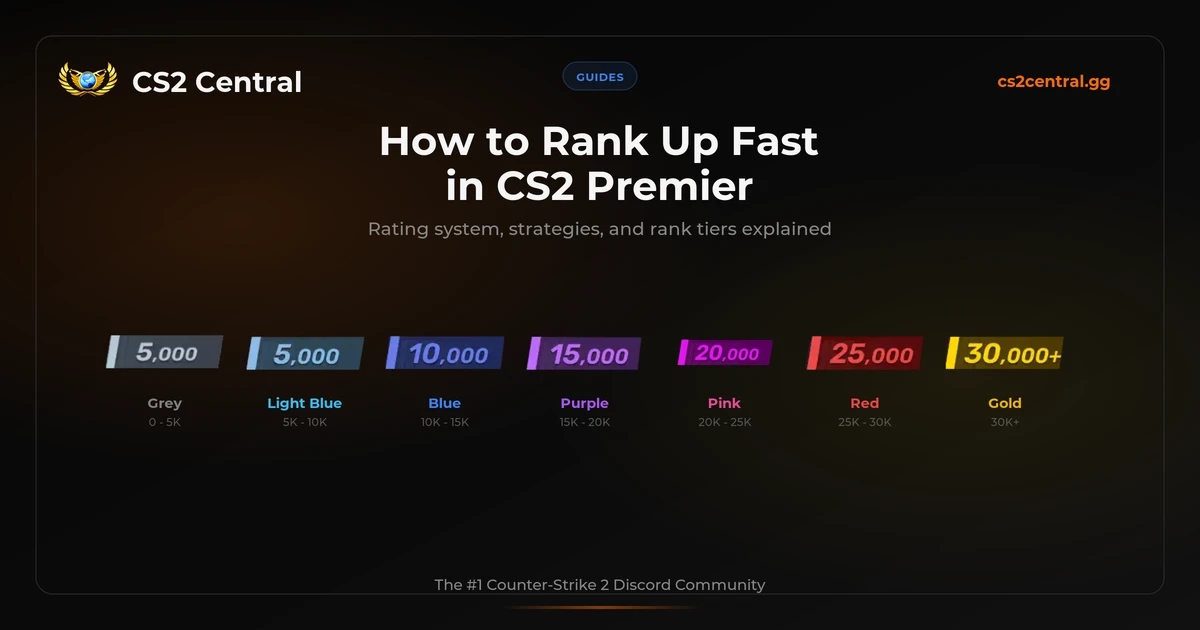
Premier uses a numerical rating that goes up when you win and down when you lose. The amount depends on how strong the opposing team is compared to yours. Internally, this is based on Glicko-2, a more advanced version of the ELO system used in chess. Your rating ranges from 0 to 35,000+ and is displayed as one of seven color tiers. You need a Prime account plus profile level 10 to access the mode.
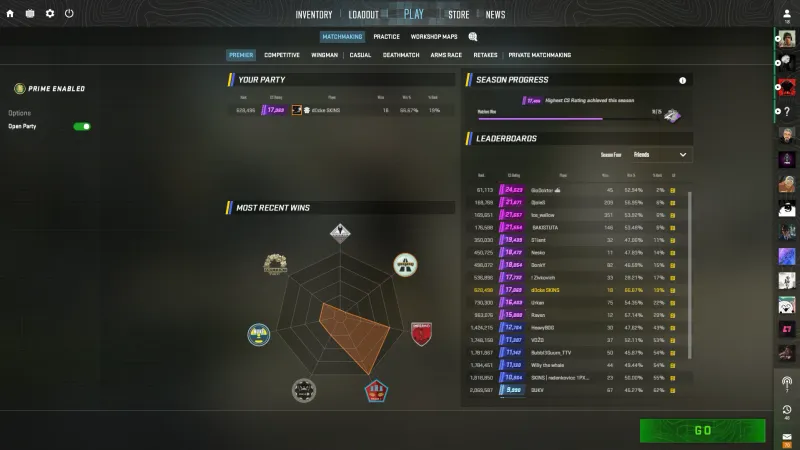
The most important thing to understand: your point gain or loss is calculated before the match starts. It is based entirely on the average rating difference between the two teams. Whether you go 30-8 or 8-20 does not change how many points you win or lose. This is a common misconception, and it frustrates a lot of players.
“You can win going 8-15 and get the same elo as someone who went 25-6.” - u/TheoWHVB on r/cs2
Round difference does play a role though. A dominant 13-4 win gives slightly more rating than a close 13-11, and a narrow loss costs less than getting destroyed.
Getting Access to Premier
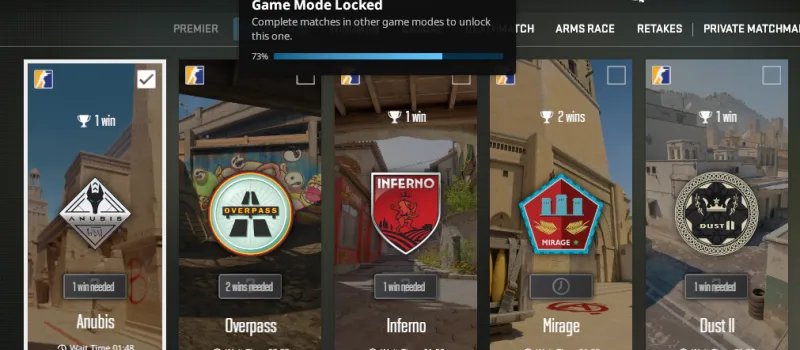
Premier is not available to everyone from the start. You need a Prime account and must reach profile level 10 before you can queue. If you have not unlocked it yet, you will see a “Game Mode Locked” message with a progress bar showing how close you are. If you are running into connection issues while trying to play, check our guide on fixing CS2 server connection errors.
Placement Matches
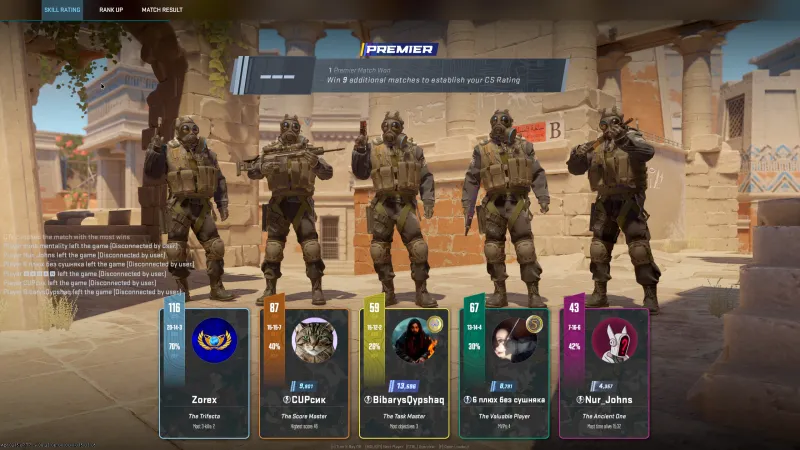
To get your first Premier rating, you need to win 10 matches. Not play 10 matches, win 10. Losses during placement do not count toward the 10, but they still affect the hidden MMR the system uses to determine where you end up. This is a critical distinction that many players miss.

The first few wins carry the most weight. According to community testing, winning your first three matches can push your hidden ELO to around 11,000 already. The system swings hard during early calibration, sometimes 300-400 points per game, before stabilizing. Winning all 10 placements can place you around 22,000-24,000, while most first-time players end up somewhere between 1,000 and 15,000.
Your previous competitive ranks also seem to influence placement. Players who were Legendary Eagle Master or higher in CS:GO tend to calibrate higher, though results vary wildly. One player reported that after playing all placement games with friends, he landed at 14,100 while his teammates got 17,000 and 22,000, despite having more kills and damage. The rating system remains opaque, and Valve has not disclosed the exact formula.
Once placed, you cannot drop below 1,000 rating. Promotion and demotion matches occur at each 5,000-point color tier boundary (4,999 to 5,000, 9,999 to 10,000, and so on).
Typical Point Changes Per Match
| Scenario | Points |
|---|---|
| Win against evenly matched team | +80 to +200 |
| Win against higher-rated team | +150 to +300 |
| Loss against evenly matched team | -100 to -200 |
| Loss against lower-rated stack | -400 to -568 |
| Placement matches (first 10 wins) | +300 to +400 |
That last row is the painful one. One unlucky game against a lower-rated five-stack can cost you 3-5 wins worth of progress. This asymmetry is the single biggest source of frustration in Premier, and there is no way around it other than not losing those games.
CS2 Premier Rating Tiers and Colors
Your numerical rating maps to one of seven color brackets. At the top of a bracket you get a promotion match, and at the bottom you get a relegation match. The average CS2 player sits around 8,000 to 9,000 in Light Blue.
| Color | Rating Range | Player Percentile |
|---|---|---|
| Grey | 0 - 4,999 | Bottom ~15% |
| Light Blue | 5,000 - 9,999 | ~15-50% |
| Blue | 10,000 - 14,999 | ~50-80% |
| Purple | 15,000 - 19,999 | ~80-93% |
| Pink | 20,000 - 24,999 | Top ~5% |
| Red | 25,000 - 29,999 | Top ~1.5% |
| Gold | 30,000+ | Top ~0.5% |
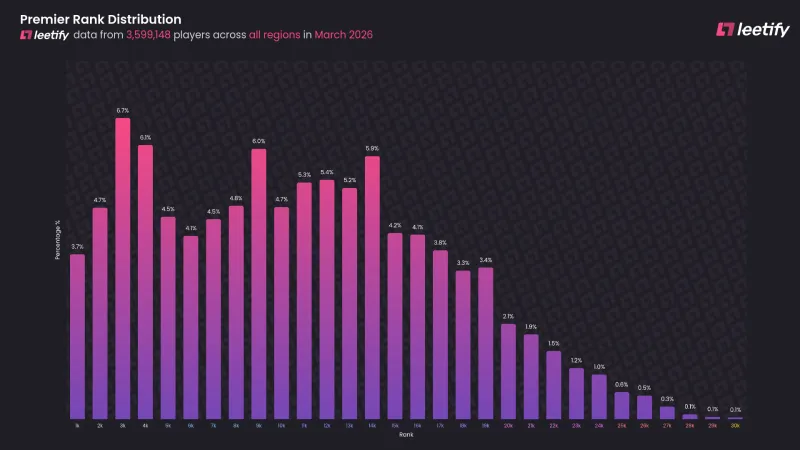
Based on Leetify data from March 2026 (3.6 million players), the biggest chunk of players sits between 2,000 and 4,000 rating in Grey, with a fairly even spread through Blue. The drop-off starts around 17,000 and gets steep after 20,000.
Premier Rating to CS:GO Rank Equivalent
If you played CS:GO, you probably still think in Silver, Gold Nova, and Global Elite terms. Here is a rough mapping based on community data and percentile overlap. Keep in mind that there is no official conversion from Valve.
| Premier Rating | Color | CS:GO Equivalent |
|---|---|---|
| 0 - 4,999 | Grey | Silver I - Silver Elite Master |
| 5,000 - 9,999 | Light Blue | Gold Nova I - Gold Nova Master |
| 10,000 - 14,999 | Blue | Master Guardian I - MG Elite |
| 15,000 - 19,999 | Purple | Distinguished Master Guardian - LE |
| 20,000 - 24,999 | Pink | Legendary Eagle Master |
| 25,000 - 29,999 | Red | Supreme Master First Class |
| 30,000+ | Gold | Global Elite |
Above 20,000, the cheater situation gets noticeably worse. Many players at that level eventually switch to FACEIT for its kernel-level anti-cheat. If you are serious about competitive CS2 and pushing high ranks, that might be worth considering. Premier is fun and the rating system makes sense, but VAC simply does not catch enough cheaters compared to FACEIT’s anti-cheat. That is the honest truth.
Seasons and Rating Resets
Premier operates on seasons, each lasting roughly 5 to 7 months, usually tied to Major tournament cycles. Season 4 started January 21, 2026 and is expected to run until around July 2026. When a new season begins, leaderboards are wiped and every player must complete new placement wins to recalibrate their rating.
The reset is a soft reset, not a full wipe. Your previous season’s rating serves as the baseline for your new calibration. But many players report being placed significantly lower than where they ended. One Reddit user went from 20,000+ in earlier seasons to below 15,000 after what they described as “pure garbage” placement games. The system re-evaluates you, and bad luck during those early matches can set you back.
To earn your season medal, you need to meet two requirements: at least 25 wins during the season, and an active (not hidden) rating when the season ends. That second requirement catches a lot of players off guard.
“It’s really annoying, because we don’t know when the season will end, so if you are out travelling, you might miss the medal because of it.” - u/Apprehensive-Ant8395 on r/cs2
Ratings above 20,000 can expire in as little as 8 days, making the final week of a season critical.
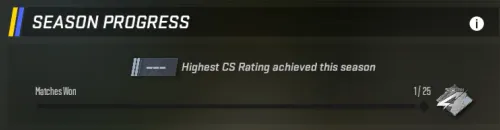
The medal you receive matches your rating color at the end of the season. Here is what the current Season 4 medals look like across all tiers:
 Grey
Grey Light Blue
 Blue
Blue Purple
 Pink
Pink Red
Red Gold
GoldInactivity and Rating Decay
If you stop playing Premier for a while, your rating will become hidden. This is not the same as losing your rating entirely. The timer scales with your current rating:
- 20,000+ rating: hidden after roughly 8-9 days
- 15,000-20,000 rating: hidden after roughly 10-14 days
- Below 15,000: hidden after roughly 2 weeks
Losses and ties do count as activity and reset the inactivity timer. You do not need to win to stay active. You can check your expiry timer by hovering on the info icon next to the Premier leaderboard in-game.

When your rating is hidden and you come back to win a match, your rating reappears. But many players report it coming back lower than where they left off. Reports range from losing a few hundred points to over 1,500 after extended breaks. However, this is not consistent. Some players have actually come back higher. One user reported going inactive at 21,200, and after winning their return match, they appeared at 24,700. The system seems to recalibrate you based on recent match quality, not just subtract a flat penalty.
Some players intentionally exploit this. By going inactive for 2+ weeks and then winning their return match, they sometimes gain thousands of rating, essentially forcing a re-placement. This works because the system becomes less certain about your skill level during inactivity, which means larger rating swings when you play again. Valve adjusted the recalibration algorithm at least once to address this, but community reports suggest the exploit still works to some degree.
Keep your rating active. If you care about your season medal or leaderboard position, play at least one Premier match every 8 days at high ratings, or every 2 weeks at lower ratings. Set a reminder if you need to.
Strategies to Rank Up Faster
1. Crosshair Placement Is Everything
Every single coach, pro player, and rank-up guide says the same thing, and they are right. Crosshair placement is the number one skill that separates ranks. At lower ratings, players aim at the ground or at body level. Keeping your crosshair at head height where enemies will appear means you need less adjustment to land the kill.
As RyderDie explains in his low ELO escape guide, about 90% of players in low Premier miss kills simply because their crosshair was nowhere near head height when the fight started. This is the single highest-impact thing you can fix.
2. Learn Counter-Strafing
In CS2, you are inaccurate while moving. Counter-strafing, pressing the opposite movement key to stop instantly before shooting, is essential for accurate gunfights. The recent reload update made ammo management tighter, so every bullet counts even more. With the new Animgraph 2 update (April 2026), counter-strafing is now visible in third-person animations too, making it a skill that is becoming more relevant than ever.
3. Master the First 10 Bullets, Not Full Spray Patterns
You do not need to memorize full 30-bullet spray patterns. louiecs2, a 3,000 ELO FACEIT player, points out that most rifles follow the same general pattern for the first 10 bullets: pull down and slightly to the right. Master that, and you will win the majority of mid-range fights. Save the full spray learning for when you are pushing past Purple.
4. Utility Wins More Rounds Than Aim
This one gets overlooked constantly. CoJoMo, a coach who has trained hundreds of players, says most people are obsessed with aim when utility is what lets you “fight level 10 players as a level 6 aimer.” Specific things to learn:
- Flash the angle the enemy is holding, not directly at them. Right-click then tap left-click for silent pop flashes.
- Smoke key positions as CT to slow down rushes. Timing your smoke is a skill in itself.
- Learn 2-3 essential molotov lineups per map to clear common positions.
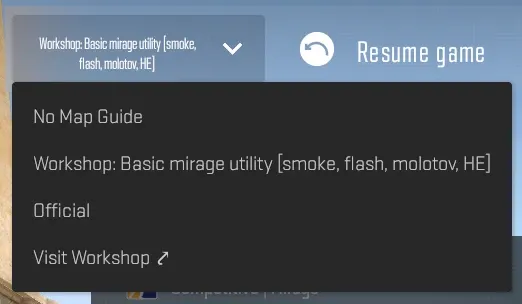
- CS2 now has built-in map guides that show you utility lineups directly in-game. Use them.
5. Trade Your Teammates
When a teammate takes a fight and dies, you need to peek immediately and get the kill. This is called trading, and failing to do it means you are giving up dozens of free kills every game. A 1-for-1 trade massively favors the T-side because you still have numbers to execute the bomb plant. Even on CT side, trading keeps the round alive. If you are hiding in a corner while your teammate dies 5 meters away, that is rating you are leaving on the table.
6. Ban Maps Strategically
Premier uses a map veto system where both teams take turns banning maps until one remains. This is similar to how professional teams play, and it gives you a real strategic edge if you use it well.
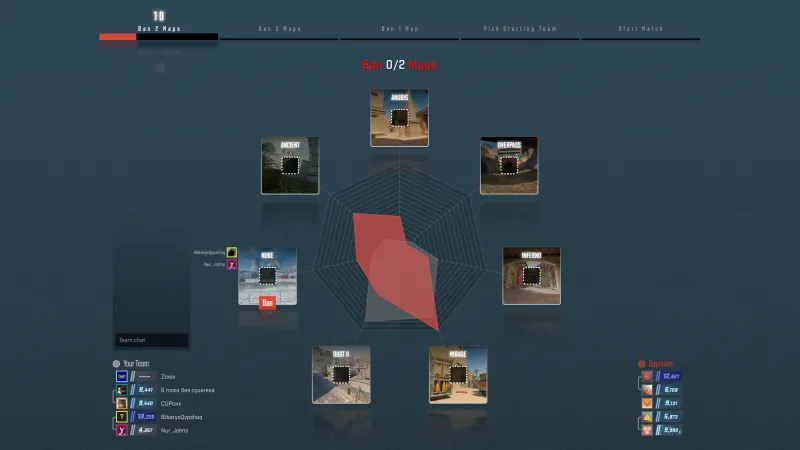
Do not just ban maps you dislike. Look at the enemy team’s profiles and stat graphs on the left side of the veto screen. If their spider chart shows they mainly play one or two maps, ban those and force them onto unfamiliar ground. Having a pool of 4-5 maps you are comfortable on gives you a significant advantage.
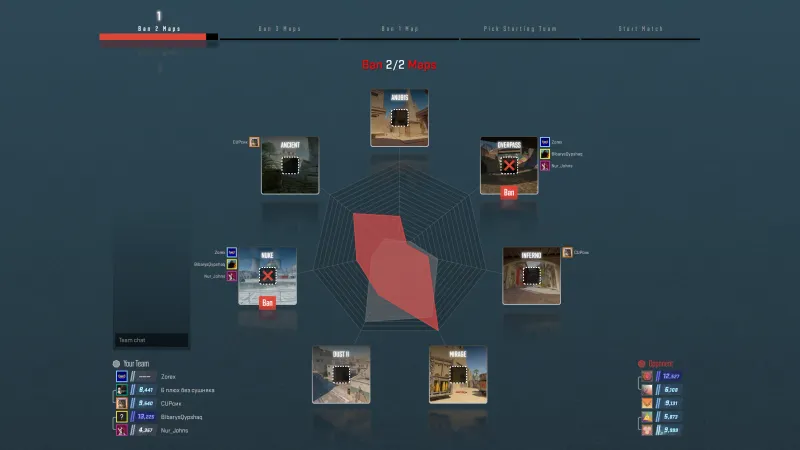
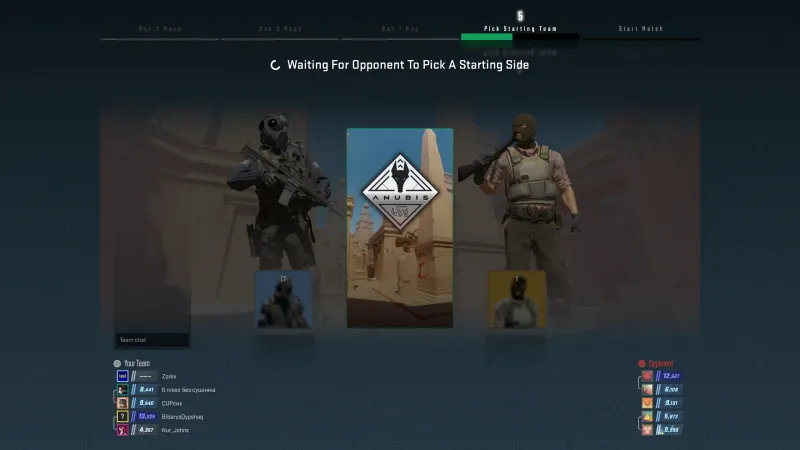
After both teams finish banning, the remaining map is selected and the team that did not pick the map gets to choose their starting side (CT or T). Knowing which side is stronger on each map gives you another advantage during the side pick phase.
Solo Queue vs. Playing with a Team
Playing with a premade duo or trio is strongly recommended. You know your teammates’ skill level, you can coordinate flashes and executes, and you avoid the randomness of toxic or uncooperative randoms. CoJoMo puts it bluntly: “If you’re not duo queuing, trio queuing, then you are already putting yourself at a disadvantage.”
If you do solo queue, accept that you will lose roughly 50% of your games. Even highly skilled players only manage about a 55% win rate solo. Do not expect callouts, smokes, or smart rotations from randoms. Step up knowing they might struggle, and focus on what you can control.
Party Size and Rating Restrictions
Premier has strict rules about who you can queue with:
- Solo, duo, trio, or 5-stack. 4-player parties are not allowed. If you have 4 friends online, one has to sit out or you need to find a fifth.
- Duo and trio: maximum rating difference of roughly 9,000-9,500 points between the highest and lowest rated player. If your friend is at 5,000 and you are at 15,000, you can still duo. But if the gap exceeds ~9,500, you will not be able to queue.
- 5-stacks: no rating limit. Since October 2025, Valve removed all rating restrictions for full 5-player parties. A 30,000 rated player can queue with a 3,000 rated player as long as the party is a full five.
- Unranked players cannot queue with rated players. You need to complete your placement wins first.
The 5-stack change is one of the most controversial decisions Valve has made. It means solo players can be matched against parties with massive rating gaps, where two high-rated players carry low-rated friends who drag down the team’s average. This leads to lopsided point changes: you might gain only +120 for a win but lose -500+ if you lose to a mixed 5-stack.
“It went to shit after they allowed full stacks with any elo difference.” - u/CryptographerPure481 on r/cs2
Looking for teammates? Finding consistent players to queue with makes a massive difference. Our Discord has dedicated LFG channels where 25,000+ CS2 players find teammates daily.
Common Mistakes That Keep You Stuck
- Blaming teammates. You cannot control what randoms do. Focus on your own plays. If nobody flashed for you on a rush, you should have been the one flashing. If you suspect someone of cheating, report them and move on. VAC bans are permanent, but they take time. If you are getting VAC authentication errors yourself, fix those before queuing.
- Warming up too long. Stop warming up when your sensitivity no longer feels slow. Over-warming drains your energy before the actual match even starts.
- Ignoring economy. Force buying every round destroys your team’s economy. Learn the loss bonus system: generally force at 1 loss, save at 2, and buy at 4.
- Wide peeking everything. Jiggle peek to bait out shots first, then swing when you have information. Jump spotting is also safer than jiggle peeking for gathering info around corners.
- Playing for kills instead of impact. Entry kills, bomb plants, and clutches matter more than padding your K/D. A player who gets 15 kills but plants the bomb 8 times is more valuable than someone with 25 kills who never takes initiative.
- Grinding 8+ games per day. Fatigue and tilt will cost you more rating than you gain. Quality over quantity.
How Often Should You Play?
This might sound counterintuitive, but playing fewer games can actually help you rank up faster. The Glicko-2 system tracks how confident it is about your skill level. When you play regularly, it is confident and adjusts your rating in small steps. When you take a break, that confidence drops, and the system makes bigger adjustments when you return. Some players report that taking a few days off and then winning gives significantly more points than grinding 6 games daily.
From experience: cap yourself at around 3 games per day, especially if you are someone who tilts easily. Premier can be incredibly frustrating, and playing on tilt leads to losing streaks that erase days of progress. If you lose two in a row, stop for the day. Come back tomorrow with a clear head.
The exception: if you are on a winning streak with good teammates and feeling sharp, keep going. Momentum is real. But the second you start feeling off, walk away.
And honestly, if you just want to have fun in CS2 without the stress, regular Competitive mode is a better fit. It is more relaxed, the per-map ranking system means one bad game does not ruin everything, and the overall atmosphere is less intense.
Premier vs. Competitive vs. FACEIT
CS2 has three main ways to play ranked, and each serves a different purpose:
| Mode | Rating Type | Anti-Cheat | Best For |
|---|---|---|---|
| Premier | Single global rating (0-35,000) | VAC + VAC Live | Main ranked experience |
| Competitive | Per-map ranks (Silver to Global Elite) | VAC + VAC Live | Casual ranked, learning new maps |
| FACEIT | ELO + FACEIT Rating | Kernel-level AC client | High-level play, fewer cheaters |
The Individual Performance Problem
One of the biggest frustrations with Premier is that your rating is entirely based on team performance. You can drop 30 kills, win every aim duel, and still lose rating because your teammates could not hold a site. The system does not care how well you played individually. You win as a team or lose as a team. Period.
FACEIT is actively solving this. With their new FACEIT Rating system launching in Season 8 (April 22, 2026), they are introducing a metric that measures your actual impact on the match. Not every kill is equal: an entry frag that opens up a bombsite carries more weight than an exit frag after the round is already lost. A clutch kill in a tight round counts for more than a cleanup kill on the last player standing. As FACEIT describes it, the system measures “what a player genuinely contributes to a team’s success, going meaningfully deeper than traditional measurements like K/D or ADR.”
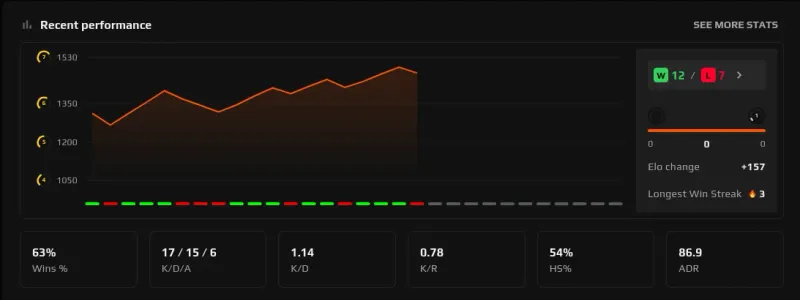
FACEIT tracks detailed performance metrics including K/D, ADR, headshot percentage, and ELO change per match. The match history below shows exactly how each game affects your rating, with green and red indicators for gains and losses.
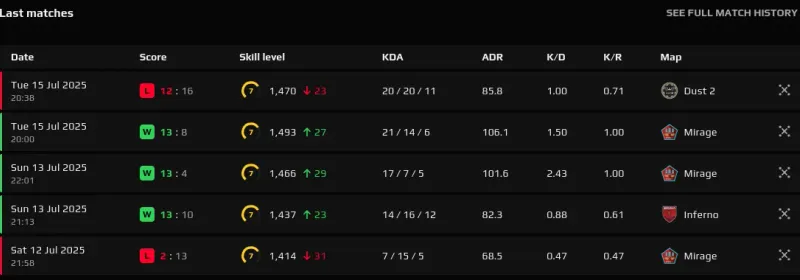
The FACEIT ranking system uses 10 skill levels instead of Premier’s color tiers. Each level has a specific ELO range, and climbing to level 10 (2,001+ ELO) is considered roughly equivalent to 25,000+ Premier rating.

Combined with kernel-level anti-cheat that actually catches cheaters, FACEIT is becoming the go-to for players who want their individual skill to matter. Premier is still the most accessible ranked mode and its rating system is easy to understand, but if you are grinding seriously above 20k and tired of losing points because of factors outside your control, FACEIT is worth considering.
Cheaters and Anti-Cheat
The reality is that many players at 20,000+ Premier are moving to FACEIT because VAC does not catch enough cheaters at that level. A data analysis of CS2 over the past two years suggests around 2% of Premier players are active cheaters, concentrated in the higher tiers. FACEIT has its own issues (ELO inflation, inconsistent game quality at mid-levels), but if you are serious about clean, competitive games above 20k, it is worth trying. Make sure your Steam account is properly secured with the Steam Desktop Authenticator before linking it to any third-party platform, and watch out for common CS2 scams targeting players on trading and matchmaking sites.
If you want to learn more about how matchmaking quality is affected, check out our CS2 Trust Factor guide. Your Trust Factor plays a huge role in whether you get clean lobbies or cheater-infested ones.
Frequently Asked Questions
How does the CS2 Premier rating system work?
Premier uses a Glicko-based rating system ranging from 0 to 35,000+. You earn or lose points after each match based on the difference between your team's average rating and your opponent's. The points are calculated before the match starts, so individual performance does not change the outcome. Winning against higher-rated opponents gives more points, while losing to lower-rated teams costs more.
How many points do you gain or lose per match?
Most players gain between 80 and 200 points per win and lose 100 to 200 per loss at mid-level ratings. Losses against lower-rated stacks can cost up to 500 points. Placement matches have larger swings, sometimes 300 to 400 points per game, as the system calibrates your skill level.
What are the CS2 Premier rank colors?
Grey (0-4,999), Light Blue (5,000-9,999), Blue (10,000-14,999), Purple (15,000-19,999), Pink (20,000-24,999), Red (25,000-29,999), and Gold (30,000+). The average player is around 8,000-9,000 in Light Blue. Less than 2% of players reach Pink or above.
Does individual performance affect my rating?
Community testing strongly suggests it does not. The points you gain or lose are determined before the match based on team rating differences. You get the same change whether you top frag or bottom frag. Round differential does have a small effect, with dominant wins giving slightly more than close ones.
Is it better to solo queue or play with a team?
Playing with a premade duo or trio is recommended. You know your teammates, can coordinate strategies, and avoid toxic randoms. Solo queuing works but expect to lose about 50% of your games regardless of skill. Accepting that makes the grind much less frustrating.
How many games per day should I play?
Around 3 games is a good limit. The Glicko-2 system may reward fewer, spaced-out sessions over daily grinding. Playing too many games causes fatigue and tilt. If you are on a winning streak, keep going. If you lose 2 in a row, stop for the day.
Why do I lose more points than I gain?
This happens when you lose to a lower-rated team. The system expected you to win, so the loss costs more. One bad loss against a low-rated stack can cost 400-500 points, while wins only give 80-150. Avoiding losses against weaker teams matters more than winning close games.
How do placement matches work?
You need to win 10 matches (losses do not count toward the 10 but do affect your hidden MMR). The first few wins carry the most weight. Winning all 10 can place you around 22,000-24,000, while most first-time players end up between 1,000 and 15,000. Previous competitive ranks also influence your starting placement.
What party sizes are allowed in Premier?
Solo, duo, trio, or full 5-stack. 4-player parties are not allowed. Duos and trios have a maximum rating difference of roughly 9,000-9,500 points. Full 5-stacks have no rating restriction at all since October 2025.
What happens to my rating if I stop playing?
Your rating becomes hidden after roughly 8-9 days at high ratings (20,000+) and about 2 weeks at lower ratings. Losses and ties count as activity. When you return and win, your rating reappears but may be lower. Some players report losing hundreds to over 1,000 points after extended breaks.
How do Premier seasons and resets work?
Seasons last 5-7 months, tied to Major cycles. At the start of each season, leaderboards reset and you must complete new placement wins. Your previous rating is used as a baseline but many players are placed lower. You need 25 wins and an active rating at season end to earn your season medal.
Should I play Premier or Competitive?
Premier is the main ranked mode with a single global rating. Competitive uses per-map ranks and is more relaxed. If you want to grind ranks seriously, play Premier. If you want to have fun without the intensity, Competitive is the better choice. For the cleanest competitive experience at high levels, consider FACEIT.
