CS.Money is the name most players think of first when someone says “CS2 marketplace.” It has been running since 2016, claims around 8 million monthly visits, and carries roughly $27 million worth of listed inventory across roughly 27,000 items and 738,000 offers. That is a huge footprint, bigger than almost anything else we have reviewed on this site.
Being the biggest does not automatically make it the best deal, though. We funded a real account, ran a bot trade, ran an instant-sell, bought two cases on the Market, and dug into the one detail most reviews gloss over: what actually happens when you try to turn your balance back into real money. Here is everything we found.
TL;DR
- Verdict: A real, established marketplace with huge liquidity, but the fees are higher than leaner rivals and a buried cash-out rule can trap your balance.
- Pricing: CS.Money paid us less than CSFloat’s reference price when we sold, and charged more than CSFloat when we bought, on every item we checked.
- Cash-out: Only balance from Market sales is withdrawable to fiat. Balance earned purely from bot Trade mode reportedly cannot be cashed out, and withdrawals only go to a Visa card or PayPal.
- Best for: Small, quick trades and instant liquidity, not for players chasing the tightest fees or planning to cash out large amounts fast.
What Is CS.Money and How the Modes Work
Signing up is simple. You click “Sign in with Steam” and that is it, no email or password of your own to set. There is no separate account creation step, which is one thing CS.Money gets right compared to sites that bolt on extra onboarding.
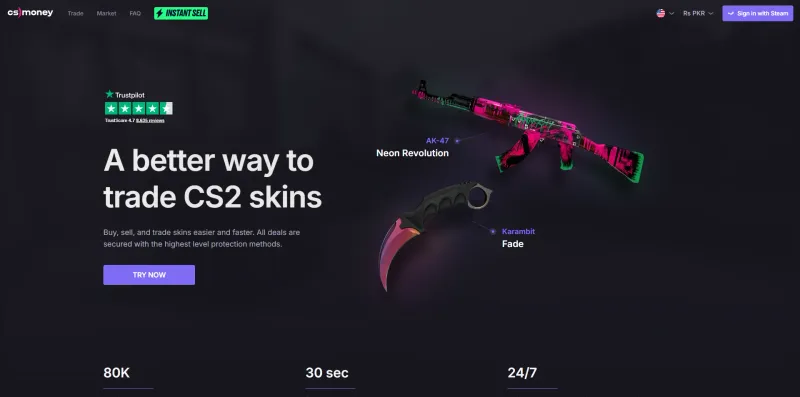
Once you are in, CS.Money runs three different modes under one roof, and they behave nothing alike:
- Trade mode is bot-to-bot skin trading. It’s good for sniping deals, but as we found while testing, the house edge is built into the pricing rather than into a stated fee.
- Market mode is a proper P2P and bot-listing marketplace where you buy and sell against other users or CS.Money’s own bot stock.
- Instant-sell only applies to CS.Money’s own bots. That is fair enough on paper, but it means some players might prefer a P2P seller instead if they want a better price.
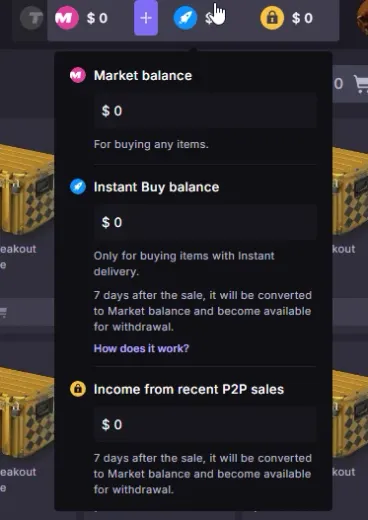
Your money is split across four separate balances. There’s a Trade mode balance, a Market mode balance, a P2P income balance that is locked for 7 days after a sale, and an instant-buy balance used only for items marked “instant delivery.” They do convert to market balance after 7 days.
CS.Money also ships a mobile app, a 3D skin viewer and an anti scam Chrome extension. The bot trades themselves land quickly. Trade mode is fast for confirming a bot deal, while Market mode’s speed depends on whether you are buying from a bot or waiting on a real P2P seller.
Buying and Selling: What the Prices Actually Looked Like
We ran a real instant-sell and two real buys to see what the numbers actually looked like against a reference site.
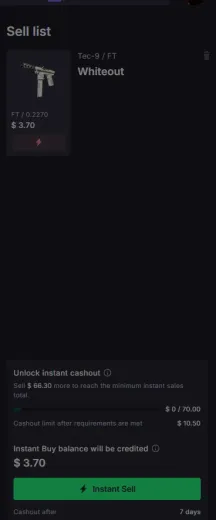
For the instant-sell, we listed a Tec-9 Whiteout (Field-Tested, 0.2270 float) and were offered $3.70. That is a fair price for the item overall, though the same float was priced better on CSFloat. That is simply how instant sell works everywhere: you trade a bit of price for zero waiting.
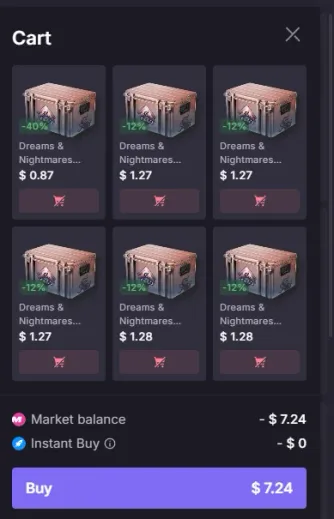
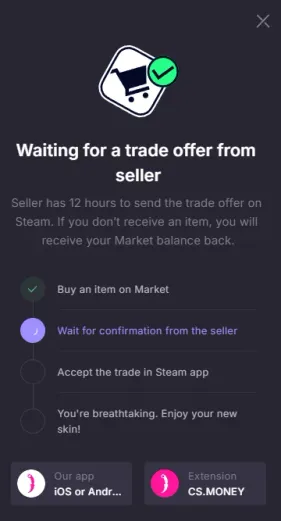
For the buys, we picked up six Dreams & Nightmares cases. Three at $1.27 and three at $1.28, all through Market mode. Waiting was not too long. We confirmed the sale on site, confirmed again from the phone, and the balance updated once we were told to wait until it cleared.
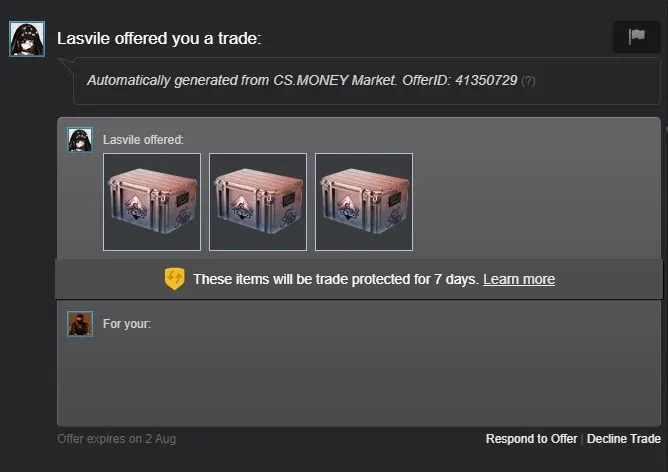
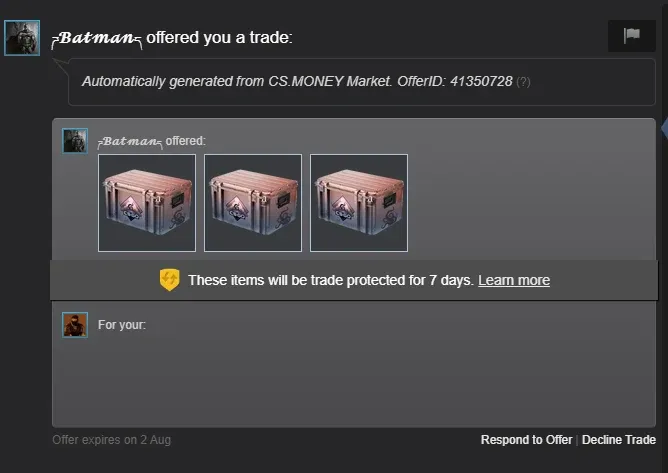
The Steam trade offers confirmed the purchase came through cleanly. Each one was generated automatically from CS.Money Market, with a 7 day trade protection window on each batch of cases.
To see how CS.Money’s pricing actually compares, we checked four items both as a sale (what CS.Money would pay us) and as a purchase (what CS.Money would charge us), against CSFloat as the reference.
Selling to CS.Money (you offer the item, this is what you receive):
| Item | CS.Money | CSFloat |
|---|---|---|
| AK-47 Bloodsport (FT) | $121.99 | $125.00 |
| MP9 Hot Rod | $176.89 | $180.49 |
| Mac-10 Fade | $50.85 | $55.49 |
| Five-SeveN Anodized Gunmetal | $17.70 | $21.33 |
Buying from CS.Money (you receive the item, this is what it charges):
| Item | CS.Money price | CS.Money’s stated discount | CSFloat |
|---|---|---|---|
| AK-47 Bloodsport (FT) | $142.08 | 26.77% | $130.00 |
| MP9 Hot Rod | $208.83 | 26.58% | $180.49 |
| Mac-10 Fade | $59.23 | 24.26% | $55.49 |
| Five-SeveN Anodized Gunmetal | $20.62 | N/A | $21.33 |
The pattern is consistent across all four items. CS.Money pays less than CSFloat’s price when it buys from you, and charges more than CSFloat’s price when it sells to you. CS.Money advertises a discount percentage on its own listings, but that discount is off its own inflated number, not off CSFloat’s reference. This matches a recurring complaint: CS.Money’s pricing does not track the wider market closely.
Fees by Mode: Trade’s 7% Plus Spread vs Market’s 5%
The fee you actually pay depends entirely on which mode you use, and the two are not close.
Market mode charges a seller fee of 5%, dropping to 3% on items over $1,000, with 0% charged to buyers on paper. But as the table above shows, the buyer-side cost is baked into the listing price instead of shown as a fee line. Trade mode charges roughly 7% commission on top of an effective 5 to 10% spread between what you offer and what you receive.
Put together with our real numbers: an item that sells for $130 on CSFloat paid us $121.99 through CS.Money and would have cost us $142.08 to buy back. That gap is wider than the stated 5% or 7% fee alone would suggest, since it is a genuine market spread on top of the commission. Market mode is the cheaper route on paper, but neither mode is cheap once you compare against a leaner marketplace like CSFloat.
Depositing and Funding Your Balance
Adding funds is split by mode too. Topping up your Market mode balance offers crypto (0% fee), PayPal (4.9% + $0.50), and cards (3% + $0.30). The minimum is around $1 to $3 depending on the method, and the flow includes a country selector.
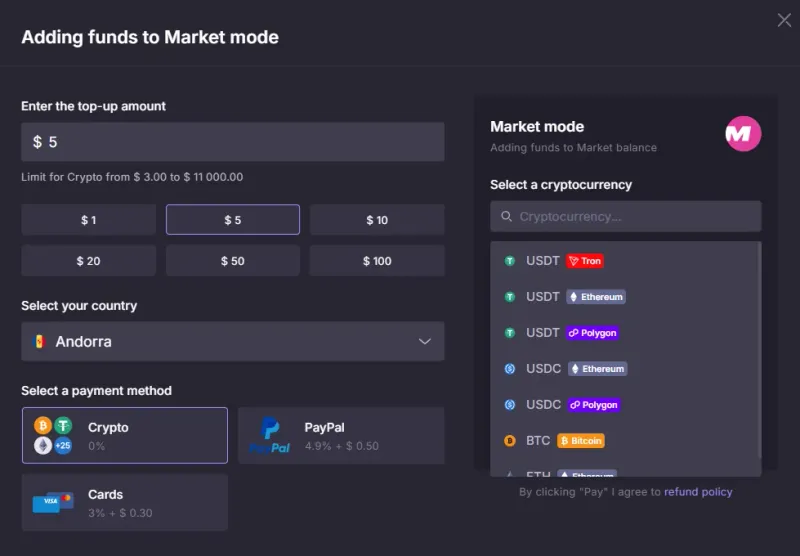
The trade balance and instant-buy balance are separate pots from the Market balance. This is the friction we ran into early on that money added in one mode is not automatically usable in another.
Cashing Out: The Withdrawable Balance Catch
This is the part every CS.Money user needs to understand before relying on the site for real money. Instant cash out balance and Market sale balance are two completely separate cash flows. Balance from an instant cash out cannot be withdrawn together with balance earned from Market sales and balance earned purely through bot Trade mode is not withdrawable to fiat at all.
To withdraw anything, KYC is mandatory. It requires being at least 16 years old, a name on your ID that matches your bank card or payment account, a government document such as a driver’s license, passport, residence permit or ID card, and a 20-second liveness clip to match your face against the documents.
Once KYC clears, there are two separate limits. Instant cash-out is capped at $70, and once the trade hold on the items behind that balance expires, the withdrawal itself goes through instantly. The maximum you can pull through this route within an 8-day window is $300. Regular Market-mode balance in your wallet can be withdrawn up to $1,000 per day to a card, usually within about an hour, with a fee of 1.5% plus $1.20. Rates vary by country, so the exchange is not always a perfect 1:1, but it is close.
Withdrawals only support Visa cards. Mastercard is not supported for cashing out, only for depositing in some regions. Confirm your card type before you count on pulling money out.
PayPal is also listed as a cash-out route on CS.Money’s own pages, alongside Visa. Whichever method you use, cash-out is geo-restricted, and the site pauses withdrawals over the weekend, from Friday 12:00 UTC to Monday 01:00 UTC. Budget for that if you are counting on same-day money.
The 2022 Hack and Trust Today
CS.Money suffered a real security breach in August 2022. A single hacker stole a significant amount of stock, and figures vary by source: some place it at $1.6 million, others around $6 million, while Wikipedia’s better sourced figure puts it near $10 million. About half was reportedly recovered, the site went offline for roughly a month, and CS.Money lost around a third of its audience in the aftermath.
That is a serious incident and worth weighing honestly. On the other side of the ledger, CS.Money has been operating for close to ten years, is backed by a company with the resources to make affected users whole, and currently sits at a 4.7 Trustpilot score from 8,635 reviews, a large and credible volume for the space. Our own concern after testing was less about a repeat hack and more about the everyday pricing gap. CS.Money is a business that needs a margin to survive, and it takes that margin by pricing skins unevenly compared to other sites. That’s a fair business model, but one to go in aware of. If you are weighing marketplace safety more broadly, our guide to CS2 scams covers the wider red flags to watch for beyond any one site.
The Referral and Partnership Program
CS.Money does not run a standard user refer-a-friend program right now. It previously ran an affiliate program open to creators with at least 1,000 subscribers, but that page has been inactive since around May 2024, over two years ago at the time of writing.
What exists today is a partnership process aimed at content creators and website owners, not everyday traders. You apply by emailing CS.Money’s marketing team with the subject line “Partnership proposal:” followed by your website or channel name. The pitch has to include a link to your platform, your monthly active users or follower count, your cost for the partnership, your CPM, and information about your content and advertising ideas.
Third-party promo codes claiming 30 to 35% top-up bonuses circulate online, but these come from affiliate marketers, not CS.Money’s own confirmed terms. Treat any such code with caution and confirm the terms directly with CS.Money before relying on it.
CS.Money Scorecard and Verdict
Our take in plain terms: CS.Money is worth using for small trades. Its “rivals” in the affiliate-review space aren’t doing much better on pricing. CS.Money is arguably about as close to a fair deal as you get, once you accept that a business this size needs a margin to stay profitable. It prices some skins higher than others compared to CSFloat simply because it can, not because of any single scandal. The withdrawable-balance catch and the region-limited, Visa-only cash-out are real dealbreakers if you are planning to move real money out quickly, and they bothered us more than the pricing spread did.
Use CS.Money if you want a big, established name, quick bot trades, and you mainly plan to spend your balance rather than cash it out. Look elsewhere, such as CSFloat or DMarket, if tight fees and a straightforward fiat withdrawal matter more to you than brand size.
Our rating: 2.9 out of 5. The heaviest axis, fees and pricing, are where we marked it down the hardest because of how unevenly CS.Money values skins against other sites. Ease of access and the site itself score full marks, and they are worth less in the formula.
Have questions about CS.Money or want to compare notes with other traders? Join our CS2 Central Discord where 25,000+ members swap prices and marketplace experiences daily.
Frequently Asked Questions
Is CS.Money legit and safe to use in 2026?
Yes, it is a real, established marketplace that has been running since 2016 with roughly 8 million monthly visits and around $27 million in listed inventory. It did suffer a serious hack in 2022, but the site has been operating normally since and our hands-on testing did not turn up any signs of a scam.
How do the different modes on CS.Money work?
There are three modes. Trade mode is bot-to-bot skin trading that is good for sniping deals, Market mode is a proper P2P and bot-listing marketplace, and instant-sell lets you cash out items straight to CS.Money's own bots for immediate balance, though usually at a lower price than a P2P sale.
Do CS.Money prices actually follow Steam or CSFloat?
Not exactly. In our testing, CS.Money paid us less than CSFloat's reference price when we sold an item, and it charged more than CSFloat when we bought comparable items. The gap held across every item we checked, so you should compare prices before trading rather than assume it matches the wider market.
What fees does CS.Money charge?
It depends on the mode. Market mode charges a 5% seller fee, dropping to 3% on items over $1,000, with 0% for buyers. Trade mode charges roughly 7% commission on top of an effective 5 to 10% buy/sell spread, so it tends to cost more overall than using Market mode.
Can you actually withdraw money you earn on CS.Money?
This is the catch to know before you start. Only balance earned through Market mode sales can be cashed out to fiat. Balance earned purely from bot Trade mode reportedly cannot be withdrawn as real money, so if cashing out matters to you, stick to Market mode sales rather than Trade mode.
How does cashing out on CS.Money actually work?
You need to pass KYC first, which requires being 16 or older, matching the name on your ID to your payment method, submitting a document like a passport or driver's license, and completing a 20 second liveness video check. Withdrawals go only to a Visa card or PayPal, with a $10 minimum, a fee of about 1.5% plus $1.20, an instant cash-out limit of $70 rising to $300 after 8 days, and a general daily withdrawal cap of $1,000, with payouts typically taking up to an hour.
